Experimental Facilities
- Home
- Experimental Facilities
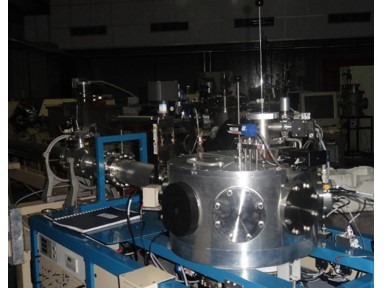
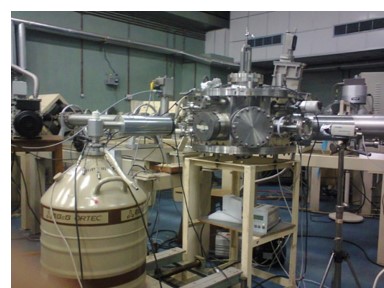
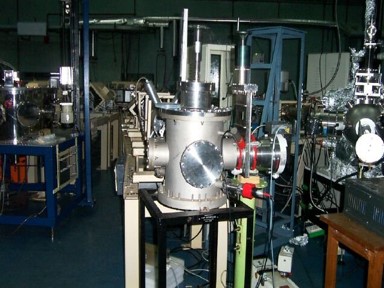
The Ion Beam laboratory of IOP consists of a NEC model 9SDH-2 tandem pelletron accelerator that can deliver positive ion beams in the energy range of 1-12MeV. The maximum terminal voltage is 3MV and can be set anywhere between 0.5-3.0MV as per requirement.
The accelerator is equipped with two negative ion sources Alphatross and MC-SNICS. Alphatross is exclusively used for producing He- ions whereas MC-SNICS is used for producing all other types of negative ions. Commonly used ion beams are that of H, He, Li, C, Si, Cu, Ag, Au.
55keV negative ions are injected into the accelerator. At the high voltage terminal, the negative ions lose electrons due to collisions with Argon gas atoms and are ejected as positive ions with high energies. The beam currents on target range from a few nano-Amperes to a few tens of nano-Amperes.
The accelerator facility is being used for studies that require IBA techniques such as RBS, ion-channeling, PIXE etc. The facility is also being used for ion-implantation and irradiation studies. Accelerator Mass Spectrometry of radiocarbon is another important feature of IBL.
Beam schedule is prepared monthly and circulated to the users on 1st of every month. Alphatross ion-source is used for RBS runs. RBS runs are scheduled if there are at least 5-6 requests from the users for beam time.
Users interested to perform experiments using 3 MV Tandem Accelerator are expected to be able to setup their own experiment and collect data. If they cannot, then they may contact any internal user of IOP for help during their run before booking the beam time.
Availability of accommodation at IOP guest house will restrict the availability of beam time to the external users. All the external users are requested to confirm their participation immediately after receiving the beam schedule for the month. They should also send the names of the participants along with arrival/departure dates at the earliest for booking accommodation.
To use any of the facility, one should fill the “Beam Time Requisition Form” and submit it on-line/ through e-mail. Beam schedule is prepared monthly and circulated to the users on 1st of every month. Alphatross ion-source is used for RBS runs. RBS runs are scheduled if there are at least 5-6 requests from the users for beam time. Users interested to perform experiments are expected to be able to setup their own experiment and collect data.
| Facility | Contact |
|---|---|
| 3.0 MV Pelletron Accelerator (NEC-make) – MCSNICS ion source | iopaf[at]iopb[dot]res[dot]in |
| Ion Beam Laboratory: Beam lines for RBS/Channeling, ERDA (End Station from NEC), PIXE, Implantation, and AMS are available | shikha[at]iopb[dot]res[dot]in |
| 50 keV Low Energy Ion implanter – SNICS ion source | iopaf[at]iopb[dot]res[dot]in |
| shikha[at]iopb[dot]res[dot]in | |
| Focused Ion Beam (FIB) (Zeiss-make): 2 keV – 30 keV (in combination with FEGSEM) | satyam[at]iopb[dot]res[dot]in |
| Low Energy Broad Beam Ion Source (Tectra GmbH-make): 50 eV – 2 keV for ion etching work (ion source coupled with Prevac-make chamber) | tsom[at]iopb[dot]res[dot]in |
| Name | Contact |
|---|---|
| 200 keV Transmission Electron Microscope (Jeol, Ultra high resolution), PP resolution: 0.19 nm | satyamiopb[dot]res[dot]in |
| 2 – 30 keV Field Emission Gun based Secondary Electron Microscope with FIB attachment. Best resolution: 1.2 nm; attachment: EDS, GIS, Liftout, Raith Lithography | satyamiopb[dot]res[dot]in |
| UHV–STM (this is an integral part of Omicrom MBE system) | satyamiopb[dot]res[dot]in |
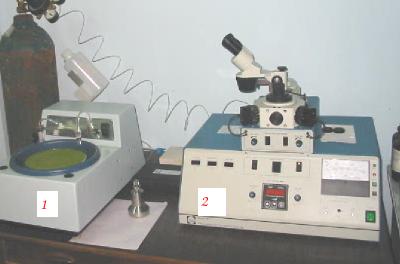
| Scanning Probe Microscopes (VEECO-make) | shikhaiopb[dot]res[dot]in |
| Large-area, High-precision Atomic Force Microscope (Asylum Research-make) | tsomiopb[dot]res[dot]in |
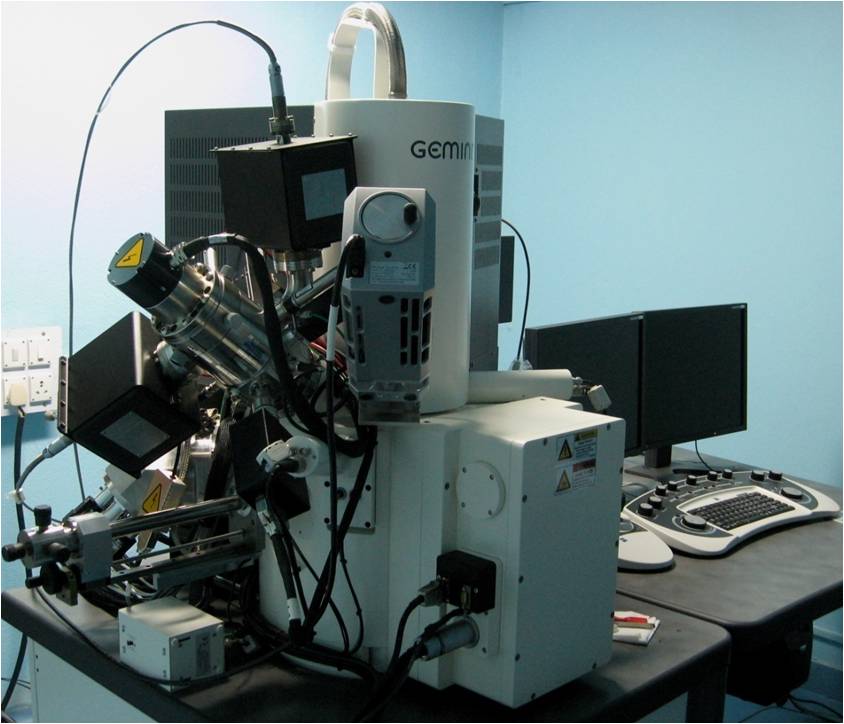
FIB-SEM at IOPB
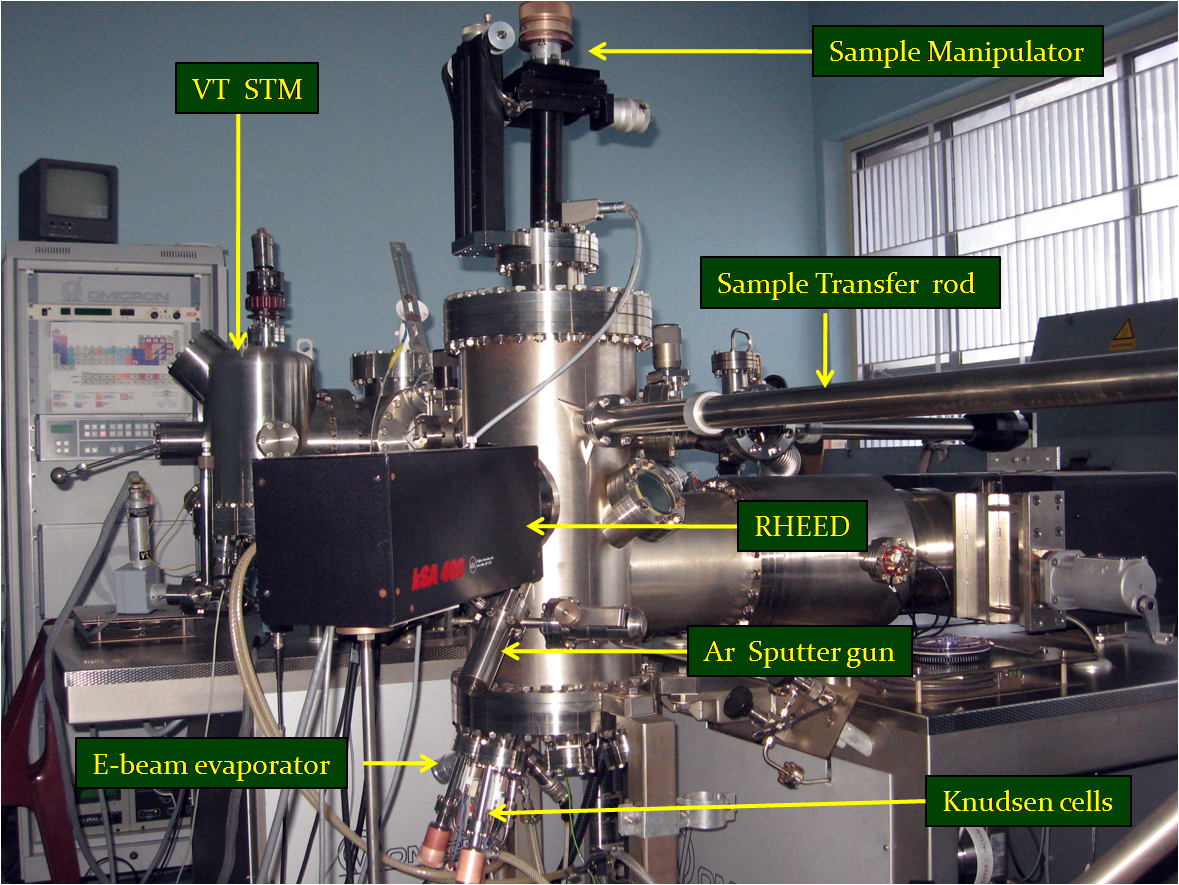
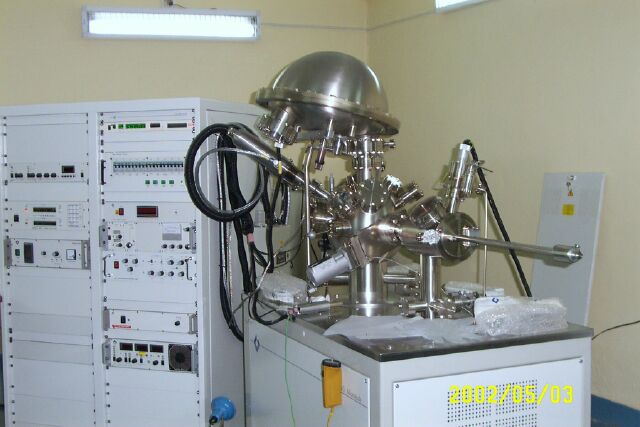
MBE and STM have been premier instruments in surface science research since last two-three decades.Molecular beam epitaxy (MBE), is one of several methods of depositing single crystals. It was invented in the late 1960s at Bell Telephone Laboratories by J. R. Arthur and Alfred Y. Cho. Molecular beam epitaxy takes place in Ultra High Vacuum (UHV~10-10 mbar) . The most important aspect of MBE is the slow deposition rate (typically less than 1000 nm per hour), which allows the films to grow epitaxially.
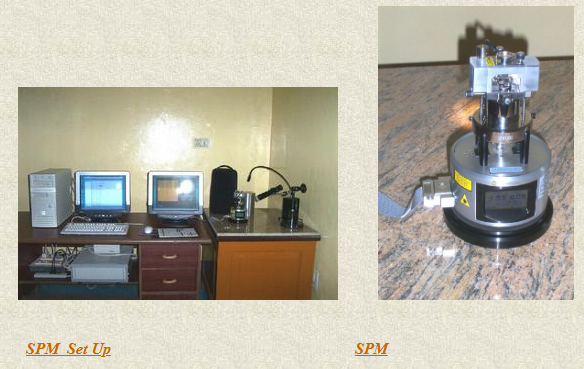
SPM is Nanoscope IIIa with Quadrex
Techniques Available : Tapping, Contact, EFM, MFM, Tapping in Liquid
Photoelectrons result from the interaction of electromagnetic radiation with matter. Useful energy range for the exciting radiation is soft X-Ray regime in X-Ray Photoelectron Spectroscopy, XPS, leading to core level electrons excitation and hence to elemental selectivity. Excited photo-electrons are analyzed according to their kinetic energy, which is, at least for core electrons, a fingerprint of the emitting element. Elemental identification is therefore possible (apart from H and He) for core level photoemission. Elements’ relative abundance can in addition be made semi-quantitative or quantitative.
Information on chemical bonds is derived either from core level shifts. Characteristic of the technique is its surface sensitivity (a few monolayers), which, combined with an etching process (usually through sputtering by accelerated noble ions) allows to measure elemental depth distributions.
The most important feature is its ability to provide detailed chemical information on virtually any kind of solid sample, i.e. also on insulating or easily damaged samples. XPS finds wide applications in several fields of science (surface physics, material science, geophysics, nanomaterials, biomaterials, polymers, organic materials,….).
| Name | Contact |
|---|---|
| X-Ray photoelctron Spectroscopy Facility (VG Scienta-make) | shikha[at]iopb[dot]res[dot]in |
| Angle Resolved UPS facility (Omicron GmbH-make) | sekhar[at]iopb[dot]res[dot]in |
| Ti:sapphire laser based up-conversion system (CDP-make) | dinesh.topwal[at]iopb[dot]res[dot]in |
| He-Cd laser (Kimon Koha-make) based Photoluminescence System (Edinburgh Instruments-make) with low temperature facility (Oxford Instruments-make) | dinesh.topwal[at]iopb[dot]res[dot]in |
| UV-VIS-NIR Spectrophotometer (Shimadzu-make) | |
| Fourier Transform Infrared Spectrophotometer (FTIR) (Thermo Nicole-make) |
| Facility | Contact |
|---|---|
| CVD set-up (indigenously built) | satyam[at]iopb[dot]res[dot]in |
| HV thin film deposition unit (Hind Hivac-make) | |
| UHV e-beam evaporation (Telemark-make 2×5.5 KW guns integrated with Excel Instruments-make UHV chamber) | tsom[at]iopb[dot]res[dot]in |
| DC/RF magnetron sputtering (Excel Instruments-make coupled with Advanced Energy-make pulsed DC and RF power supplies) | tsom[at]iopb[dot]res[dot]in |
| Molecular Beam Epitaxy (MBE) with RHEED, STM, 3 Knudsen Cells for evaporation of Ge, Au and Ag; e-beam evaporator (Omicron GmbH-make) | satyam[at]iopb[dot]res[dot]in |
| Low Energy Cluster Beam deposition (LECBD) machine (indigenously built) |
| Facility | Contact |
|---|---|
| Powder Diffractometer (Bruker-make) | dinesh[dot]topwal[at]iopb[dot]res[dot]in |
| High-resolution XRD system with reciprocal space mapping (Bruker-make) | tsom[at]iopb[dot]res[dot]in |
| 18 kW Rotating Anode based X-ray Reflectometry and X-ray Standing wave facility (with Rigaku-make X-ray system and a Huber-make 4-circle difrractometer) | satyam[at]iopb[dot]res[dot]in |
| X-ray Fluorescence set-up |
| Facility | Contact |
|---|---|
| Chemical Labs (with ductless fumehood (Esco-make), centrifuge, LB film deposition set-up (Nima-make), Spin coater, Milli Pore Water purifiers, LCR Meter) | |
| Furnaces: Rapid Thermal Annealing Unit, Low Vacuum Furnace | |
| Surface Profilometer (Ambios-make) | tsom[at]iopb[dot]res[dot]in |
| Cyclic Voltameter set-up (Ecochemie B.V.-make) | shikha[at]iopb[dot]res[dot]in |
| Facility | Contact |
|---|---|
| SQUID–VSM based MPMS System (Quantum Design-make) | squidvsm[at]iopb[dot]res[dot]in |
| Pulsed laser deposition unit (Coherent GmbH-make laser coupled with Excel Instruments-make chamber and optics) | tsom[at]iopb[dot]res[dot]in |
| Low energy Ion Milling Station | satyam[at]iopb[dot]res[dot]in |
| Probe-station, Transport Facilities | satyam[at]iopb[dot]res[dot]in |
| High temperature Furnaces (in high vacuum) (MTI-make) | tsom[at]iopb[dot]res[dot]in |
| Plasma Cleaner | satyam[at]iopb[dot]res[dot]in |
| PPMS System | dinesh[dot]topwal[at]iopb[dot]res[dot]in |
| Spectral Response Set-up | tsom[at]iopb[dot]res[dot]in |
| Confocal Microscope (with micro-Raman spectrometer option) | shikha[at]iopb[dot]res[dot]in |